
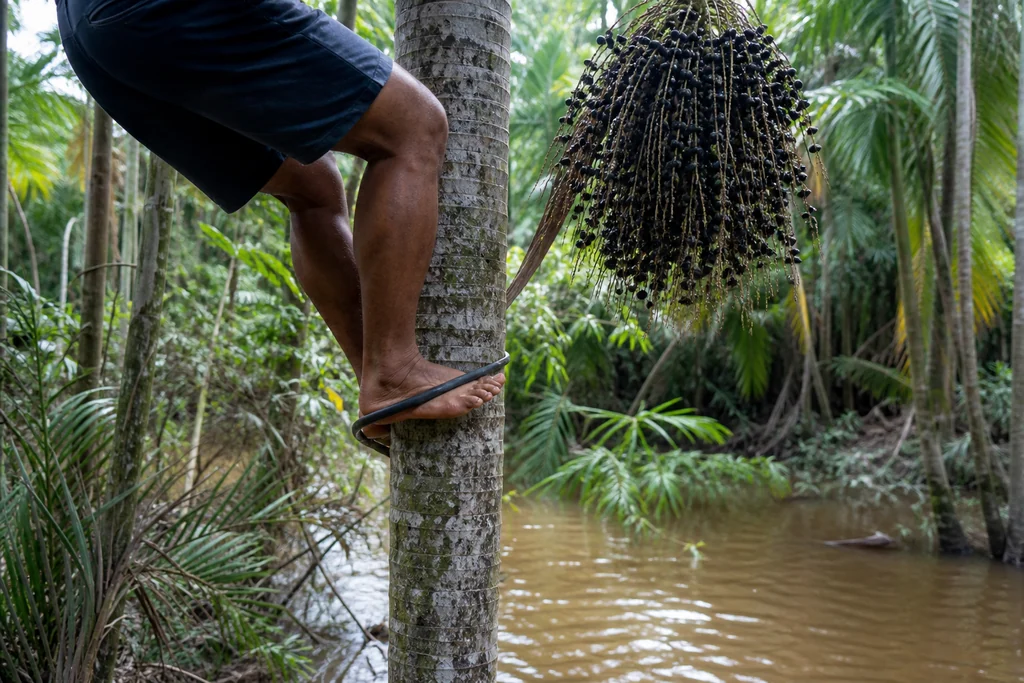
Before açaí becomes pulp, food, export product, or Amazonian symbol, it passes through a less visible stage: harvesting. In many riverside and extractive communities, that stage is associated with the peconha, a traditional tool connected to the work of collecting fruit from açaí palms. This article presents the practice as cultural, productive, and occupational context. It is not an instruction manual, does not explain climbing technique, and does not replace professional or community-based training.
In the traditional açaí chain, the peconha can be understood, in general terms, as a fiber loop used in the context of harvesting tall palms. That broad definition is enough to orient the reader. Operational details are deliberately outside the scope of this text, because they would turn an editorial explanation into practical instruction. The point is not practical use. The point is what the peconha reveals about the work behind part of the açaí economy.
The practice exists because native açaí palms grow in floodplain environments and may hold their fruit bunches high above the ground. Over generations, riverside communities developed their own ways of working in that environment, combining local knowledge, physical experience, and adaptation to the forest and river cycles. The peconha belongs to that repertoire. It is not a picturesque detail: it is part of a craft learned in community context, within a daily relationship with the territory. Another article in this Atlas describes, in more detail, how açaí is grown and harvested.
That generational dimension appears in recent journalism. CNN Brasil, in a report on riverside communities in Belém, presented the case of Raimundo, a resident of Ilha do Cumbu who, at 68 years old, had 58 years of experience harvesting açaí. The example should not be read as a universal portrait of all harvesters or all regions, but it helps show that the practice is not a tourist performance or an isolated scene. It is connected to families, food, income, and working memory.
The economic scale also explains why the subject matters. According to a report from Brazil’s Regional Labor Court for Pará and Amapá, based on a diagnosis by Instituto Peabiru and Fundacentro, the activity involves more than 120,000 families, with Pará and Amapá accounting for more than 80 percent of Brazilian production in the cited context. The same diagnosis estimated that, on a peak harvest day, there may be more than 1 million ascents of açaí palms. These figures belong to a specific study and should not be treated as permanent universal statistics, but they make one thing clear: traditional harvesting is not a marginal activity.
A 2024 report by Repórter Brasil reinforces that view from another angle. It shows that the expansion of the açaí market, including beyond Brazil, has increased pressure on those at the beginning of the chain. Brazilian açaí production reached 1.7 million tons in 2022 and generated more than R$6.1 billion, after strong growth since 2018. In Codajás, in the state of Amazonas, the report describes a production hub involving thousands of collectors. The economic data matters because it prevents a simplistic view: the fruit circulates through broad markets, but its first stage still depends on local, physical, and risky work. Another article in this Atlas covers the açaí market and supply in more depth.
This is where safety needs to enter the article with care. The diagnosis cited by TRT8 examined a typical harvesting area on the Canaticu River, in Curralinho, Marajó, between 2015 and 2016. Among respondents, 89 percent said that someone in their family or a share worker had already suffered a work accident in the açaí grove; 54 percent of the reported cases led to hospitalization; and 62 percent required time away from the activity. These data do not justify generalizations about the entire Amazon today, but they document a real and relevant occupational risk.
The concern remains current. Repórter Brasil interviewed workers, specialists, and authorities about accidents, injuries, and the intensification of harvesting. The report cites labor prosecutor Gabriela Menezes Zacareli in connecting the worldwide popularity of açaí with greater pressure on traditional communities and a worsening risk of accidents and long-term injuries. Again, the purpose is not to dramatize harvesting. It is to recognize that a concrete occupational issue sits behind a product that is increasingly valued.
This perspective also appears in academic literature. Silva and Ferreira, in a 2020 article on the work of the peconheiro in the Amazon region, analyze the activity through the concept of decent work. The abstract supports the view that peconheiros experience risk, violations of rights and fundamental guarantees, and working conditions that do not meet the standard of decent work. For Açaí Atlas, this source helps place the peconha within a broader discussion: tradition should not be celebrated while working conditions remain invisible.
At the same time, reducing the peconha only to risk would also be incomplete. It expresses practical knowledge, environmental adaptation, and cultural continuity. The editorial challenge is to keep these elements together: tradition without romanticizing it, safety without sensationalism, and economic scale without erasing the person who harvests. The açaí chain begins before processing, branding, and consumption. It begins with the work that makes the fruit circulate.
For that reason, talking about the peconha means talking about a delicate boundary between culture, income, and protection. For readers outside this world, the responsible role is not to reproduce the practice, but to understand it with respect. The peconha belongs to a specific craft, learned inside the communities that practice it. What readers can take from this article is something else: the awareness that every bowl of açaí carries a history of knowledge, effort, and risk that deserves to be seen seriously.
Leave a comment