
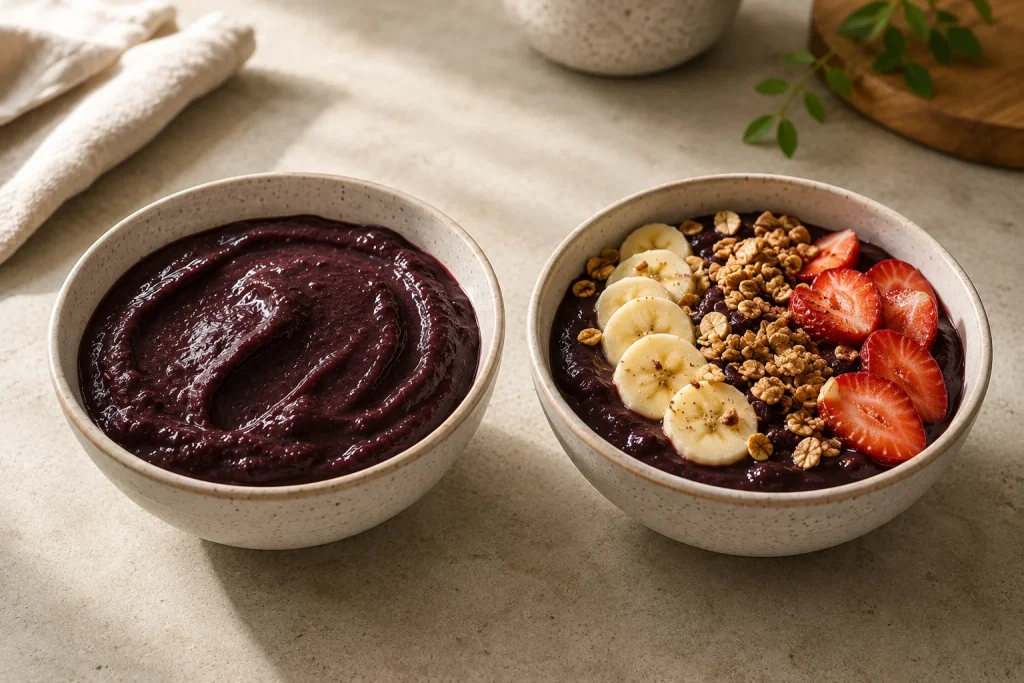
Order the same thing in two different places and you might end up with two very different bowls. The explanation isn’t in the name — it’s in what actually goes into it.
Order an açaí bowl at one juice bar, then order another a few blocks away at a smoothie shop. The name on the menu is identical. What lands on the table isn’t necessarily.
That’s not a quality issue, and it’s not really a debate about which version is more “authentic.” It’s something else: “açaí bowl” names a preparation, not a fixed recipe. And when the name doesn’t define the recipe, the useful question stops being “is this healthy?” and becomes something simpler — and more useful: what’s actually in this bowl?
The Base Isn’t Always the Same
Before any toppings come into play, the base itself can already vary — because “açaí pulp” isn’t a single product either.
Brazil’s TACO food composition database, maintained by NEPA-UNICAMP at the University of Campinas, offers two entries that make this easy to see side by side. A frozen açaí pulp with no added sugar comes in at about 58 calories and 6.2 grams of carbohydrate per 100 grams. The same table also lists a version prepared with guaraná syrup and glucose, at 110 calories and 21.5 grams of carbohydrate for the same amount. Fiber drops too, from 2.6 to 1.7 grams. It’s not just “more calories” — it’s a different composition, period.
These two entries aren’t the extremes of everything sold as açaí. They’re just two real products, with similar names, that show why formulation matters more than the label alone can tell you.
One quick note on fat, since it tends to surprise people: açaí pulp has a relatively high fat content for a fruit, mostly unsaturated. That’s not a red flag or a selling point — it’s just another variable in the composition, the same logic that already applies to carbs and fiber.
In Brazil, this variation is real enough to have its own regulatory category: the country’s agricultural authority, MAPA (the Ministry of Agriculture and Livestock), sets rules for açaí sold as a beverage, including a sugar limit for a product to still be labeled that way. That’s a Brazilian rule, not a US one, and it’s not the focus of this piece — but it confirms, with legal weight, what the composition data already shows: not every açaí preparation is the same thing.
It’s also worth remembering that commercial variation doesn’t cover every way people relate to the fruit. In parts of the Brazilian Amazon, especially the state of Pará, açaí is also eaten as part of savory meals, paired with fish and cassava flour — a very different context from the sweetened bowl that became popular internationally. That difference doesn’t need to become a contest over which one is “more authentic.” They’re simply different uses of the same fruit, in different places and different moments of its history.
Where the Sugar Can Come From — and What Else Goes In
That raises a question that tends to split opinion: does açaí have a lot of sugar, or none at all?
The answer depends on which product is being described. A pulp with no added sugar looks very different from a sweetened preparation, like the syrup example above: there, added sugars are already part of the formulation before the pulp ever reaches a bowl.
And the finished bowl adds a third layer: toppings. Granola, honey, fresh fruit, nut butter, and other common additions also become part of the final composition — and depending on the choice and the amount, they add carbohydrates, sugar, fat, fiber, and calories. None of these ingredients is “wrong”: they’re as much a part of the result as the base is, and it’s the sum of all of them, not any single one, that defines the bowl in front of you.
In other words: neither “açaí has no sugar” nor “açaí bowls are loaded with sugar” — used as a blanket rule — describes the category well. Every product, every serving size, every combination of add-ins tells a different story.
When Size Is Part of the Formula
There’s another variable that tends to go unnoticed: there’s no standard size for an açaí bowl. Every chain, every shop, sets its own sizes — and that alone changes the total amount consumed, even when the base formulation is identical.
A real example shows the combined effect of all this. Jamba Hawaii — a regional operation, separate from Jamba Juice’s national menu — publishes nutrition information for its “Acai Super-Antioxidant™” line in three sizes. The smallest comes in at 260 calories and 46 grams of sugar. The medium size rises to 380 calories and 66 grams. The largest reaches 520 calories and 94 grams of sugar — roughly twice the smallest as the serving size increases.
That doesn’t mean every commercial açaí bowl falls between 46 and 94 grams of sugar. It’s the range for one specific product, from one specific operation, in those specific sizes. But it illustrates well why a general question like “how many calories are in an açaí bowl” rarely has a single answer.
And the variation doesn’t run in just one direction. Sambazon, another well-known brand in the category, sells a line of pure frozen pulp with no added sugar, at around 70 calories per serving — a commercial example that unsweetened formulations exist in the market too.
So, Is an Açaí Bowl Healthy?
It’s the most common question about the topic — and also the hardest to answer well, because “açaí bowl” isn’t one food with one answer.
Plain pulp, sweetened pulp, and a full bowl with toppings are three nutritionally different things, even though all three share the same name. Asking whether an “açaí bowl” is healthy is a bit like asking whether a “sandwich” is healthy: it depends entirely on what’s inside.
The same goes for the word “superfood,” sometimes used to describe açaí. It’s a marketing term, not a nutritional classification — there’s no technical or regulatory definition behind it, and using it doesn’t replace looking at the actual composition of a specific preparation.
In practice, a few simple questions are worth more than any label:
| What to check | Why it matters |
|---|---|
| The base | Plain, sweetened, or another preparation — the starting point already varies |
| Added sugar or syrup | Can meaningfully change the carbohydrate, sugar, and energy content |
| Serving size | Changes the total amount consumed, even when the recipe is the same |
| Toppings | The final layer — adds fat, sugar, or fiber depending on what’s chosen |
None of these questions require technical knowledge. They just require looking at the specific bowl in front of you, not its name.
An açaí bowl isn’t a fixed formula — it’s a category with room for very different preparations under the same name. That’s not a reason to distrust the dish, or to treat the name itself as shorthand for either indulgence or health. It’s simply a reminder that, with this food as with many others, understanding what’s in the bowl is worth more than trusting the name alone.
Related reading: the origin of açaí and how it reached the international market.
Leave a comment