
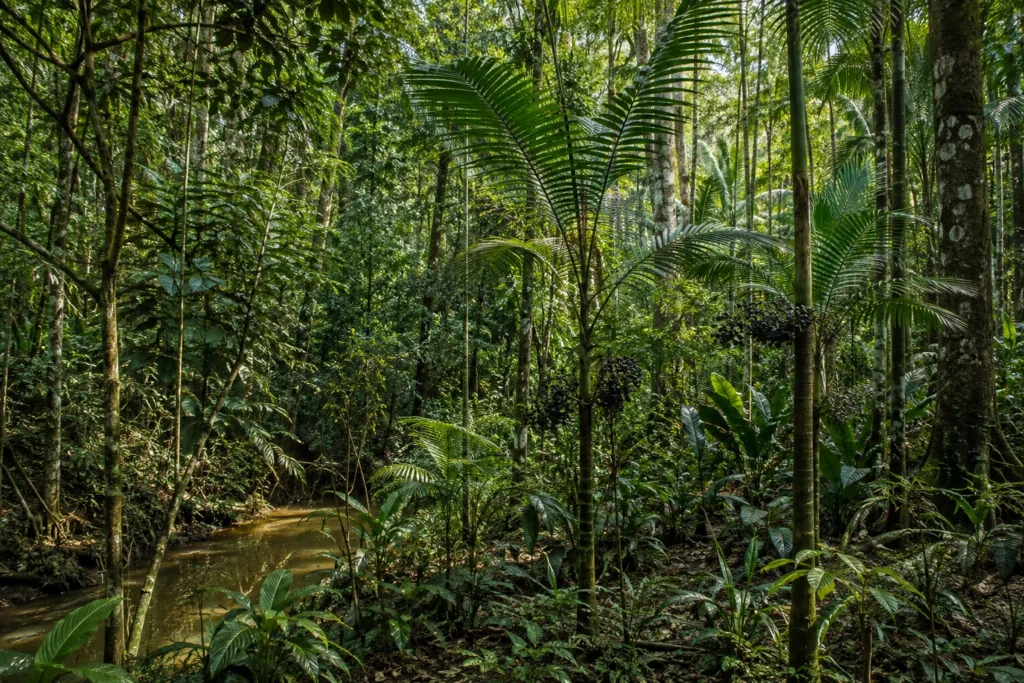
A landscape can look perfectly green, with no visible sign of deforestation, and still have lost much of the life that made it function as a forest. It sounds like an odd paradox, but it’s exactly what researchers found studying areas of intensive açaí management in the Amazon estuary, in Pará, Brazil: the landscape still looks green and intact. On the ground, though, the diversity that sustains that ecosystem may already have shrunk considerably.
That doesn’t mean açaí “deforests” the Amazon in the classic sense — there’s no clear-cutting here, no bare soil. What happens is subtler, and harder to notice: as management intensifies to produce more fruit, the forest around the açaí palms tends to simplify from the inside. Understanding that difference — between a forest that’s cleared and a forest that quietly grows poorer while still standing — is the starting point for any serious conversation about sustainability in the açaí chain.
The same fruit is, at the same time, a real source of income for thousands of riverine families, a fast-growing export product, and a centerpiece of what’s increasingly called the Amazon bioeconomy — the idea that keeping the forest standing can be worth more, economically, than clearing it. The question this article tries to answer isn’t whether açaí is good or bad for the environment. It’s a different one: what actually determines whether a given açaí production system is sustainable — and what do we still not know about that?
Part of the answer already appeared in this Atlas’s article on wild, managed, and cultivated açaí: açaí doesn’t come from just one kind of place. It can come from lightly managed native stands, from carefully managed areas, from productive floodplains, or from upland cultivation — each system with its own logic of labor, environment, and impact. Here, the starting point is different: within any of those systems, one variable keeps showing up as the one most clearly linked to measurable ecological consequence — how intensively the palm stand is managed.
When more açaí changes the forest
Managing an açaí stand isn’t a binary choice between “leaving it alone” and “turning it into a plantation.” It’s a matter of degree. A natural açaí stand typically has around 100 clumps per hectare. Pará’s own regulations allow management to raise that number to as much as 400 clumps per hectare. In practice, though, researchers have recorded managed stands with more than 1,000 clumps per hectare — well beyond what the regulation itself allows, driven by rising demand and the income each additional clump can represent.
This isn’t a story about producers acting in bad faith. It’s a rational response to real incentives: more açaí per hectare usually means more income per hectare, especially as fruit prices rise and the international market grows. The problem is that the same intensity driving that extra income is, according to the two most directly relevant studies published on the subject, also the variable most closely tied to loss of diversity.
What the science is measuring
The first of these studies, published in 2021, compared dozens of floodplain forest areas in the Pará estuary with different açaí densities, and found a clear negative relationship between rising density and the richness and abundance of the forest’s other trees. Commenting on the results, the study’s lead author estimated that in areas near 200 clumps per hectare — still within the legal limit — the loss of woody species richness reaches around 60 percent. In some of the most intensively managed areas, açaí palms already dominated the landscape almost on their own, with very few other trees left standing.
The second study, published in 2026 by the same research group, looked at an entirely different group: birds. Across 36 forest areas spread over four municipalities in Pará, along a gradient running from 11 to more than 1,400 clumps per hectare, the researchers reported that, in the highest-density areas studied, bird species richness fell by around 28 percent compared with the lower-density areas of the same gradient — an effect strongest specifically among insectivorous birds and species that depend on well-structured forest to survive.
Both studies, covering different biological groups, point in the same direction: the more intense the management, the more the landscape simplifies on the inside, even as it stays visibly green. Neither one, though, allows us to say this holds for the whole Amazon, for açaí production in general, or for upland, non-floodplain systems — the data come specifically from floodplain forests in the Pará estuary, and that’s how they need to be read.
The other side of the equation
On the other side of that equation is a real economy, not a hypothetical one. Brazil’s açaí production already totals millions of metric tons a year, with exports growing to the United States, Europe, and Asia. Cooperatives of riverine families have, in some cases, managed to plug directly into that international market: a cooperative of producers from Bailique and Beira Amazonas, in the state of Amapá, working under certified extractive management, recently signed a contract to supply thousands of metric tons of açaí to China over the coming years. It’s a concrete example — not a general rule — that there is a path where certification, community organization, and international markets can meet.
What a label actually guarantees
That raises an obvious question: if certification can open that kind of door, does a sustainability label solve the problem? The available evidence suggests a two-part answer.
On one hand, certified areas studied have, on average, more than 50 percent more tree species than areas under non-certified management, and their loss of richness under intensification is less pronounced. That association matters, but it doesn’t, on its own, prove that certification caused the difference — the researchers themselves acknowledge there wasn’t enough prior monitoring to fully separate what these areas already looked like before certification from what certification itself changed. Even so, the measured difference suggests certification isn’t just a label — it’s associated with a real outcome on the ground, even if the exact cause hasn’t been isolated yet.
On the other hand, a 2024 study on voluntary sustainability standards in the açaí chain — based on interviews with five companies that agreed to take part, out of an initial group of fifteen invited — found something more uncomfortable: the companies’ own sustainability self-assessments, when checked against real indicators, turned out to be vulnerable to opacity and inconsistencies that the researchers linked to greenwashing risk. The main difficulty was measuring, and especially disclosing, negative results. It’s a serious finding, but it comes from a small sample; it isn’t evidence that açaí certification, as a category, is a facade — it’s evidence that self-assessment without external verification has a real blind spot.
That same blind spot has shown up, in a more isolated way, elsewhere: some public criticism of environmental investment projects tied to açaí has focused specifically on how the funding companies communicate that investment — not on whether the communities or cooperatives receiving support are actually practicing real management. These are related problems, but distinct ones, and they’re worth not confusing.
Traceability isn’t the same as sustainability
A certification label also shouldn’t be confused with another tool gaining ground in the açaí chain: traceability. Digital platforms — some private, some public, like a traceability project under development in Amapá — now make it possible to follow the fruit from harvest to processing, identifying batch, origin, and, in some cases, the producer. That solves a real problem: knowing where the açaí came from and whose hands it passed through. It doesn’t, by itself, answer a different question: whether that specific management preserved the area’s biodiversity, or whether the income it generated actually reached the people who harvested the fruit. Traceability proves origin. Sustainability is a different question — related, but not the same one.
Given all this, the most defensible path isn’t to sort management into fixed categories of “good” or “bad,” but to look at what the evidence actually supports: management within the legal density limit already carries a measurable ecological cost, and exceeding that limit — already documented in the areas studied — likely makes that cost worse. Real, properly enforced certification appears to reduce that impact without eliminating it. No source consulted in this research points, today, to what a biodiversity-safe density would actually be — that number, if it exists, hasn’t yet been published with the rigor needed to cite it here.
In fact, there are more open questions than one might expect. We don’t have solid data on how income generated by the açaí chain is distributed among harvesters, cooperatives, processors, and exporters. We don’t know whether the biodiversity-loss pattern measured in the Pará estuary repeats at the same intensity in other producing regions. And we don’t know, with the same quality of evidence used here, how working conditions have evolved in certified areas compared with non-certified ones. None of these gaps invalidates what we do know — but none of them should be filled in by assumption, either.
Maybe the most honest answer to the question that opened this article is this: there’s no single label that can sum up whether an açaí is sustainable or not. There’s a set of specific questions — about management intensity, about real enforcement of certification, about how income gets distributed — that need to be asked separately, region by region, system by system. Açaí Atlas has already shown, in writing about traditional harvesting, that behind every bowl of açaí there’s labor, risk, and accumulated knowledge. This article adds another layer to that same chain: the landscape where the fruit grows carries its own story too — one of real income, of science still in progress, and of questions that remain more honest than any simple answer.
Leave a comment