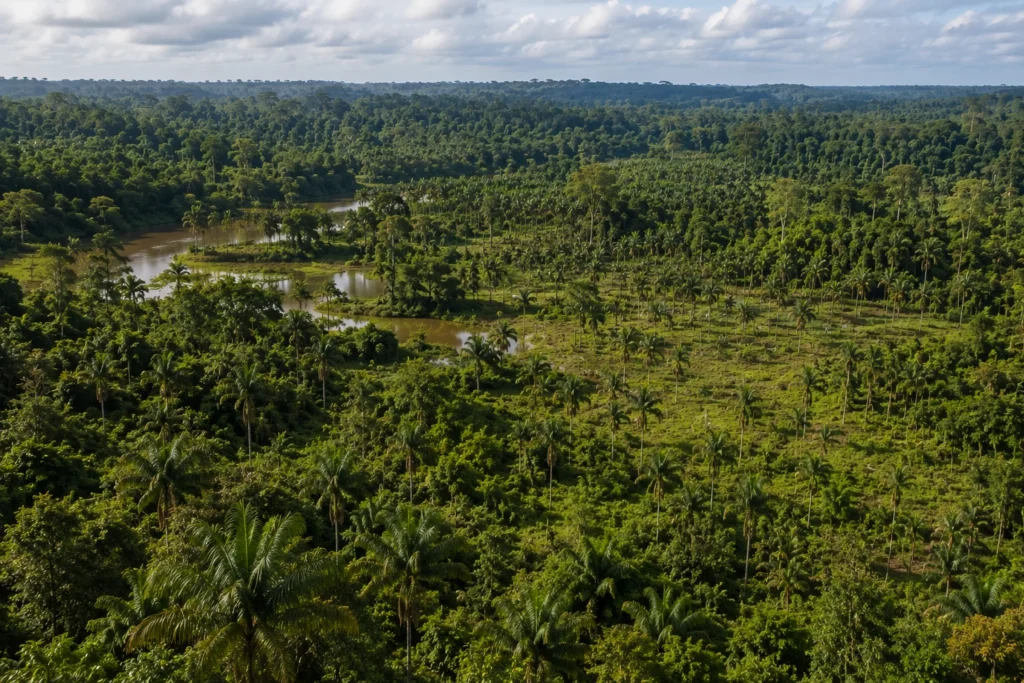
At first glance, the question seems simple: there is wild açaí, and there is cultivated açaí. One would come from the forest, the other from planting. But that opposition, although easy to understand, does not explain the reality of Amazonian production very well. Between a native açaí stand and a planned cultivation system, there is an important zone of management, technique, environment, and production history.
For that reason, the most useful question is not only whether açaí is “wild” or “cultivated.” A better question is: in what production system was it grown? The fruit may come from lightly managed native areas, from managed native açaí stands, from productive Amazon floodplains, or from cultivated upland systems. Each situation changes how work is organized, how productivity is understood, how environmental impact is discussed, and what kind of knowledge is involved.
A native açaí stand is one that occurs in a natural environment, especially in the wet landscapes of the Amazon. In the case of the açaí most closely associated with Pará and the Amazon estuary, the central species is Euterpe oleracea, a palm that can form clumps with multiple stems. That detail may sound technical, but it helps explain why açaí became so important in certain floodplain landscapes: the plant can form dense and productive populations when conditions are favorable.
Even in native areas, however, “natural” does not necessarily mean absence of management. Many açaí areas are shaped by human intervention, selection, clearing, guidance, and organization of the surrounding environment. Management can favor the presence of açaí palms, reduce competition with other plants, and improve access for harvesting. In other words, an açaí stand can remain native while also being managed by people who know that territory.
This distinction matters because it avoids two common mistakes. The first is assuming that every açaí from a native area is untouched. The second is assuming that every cultivated system is artificial in a negative sense. In practice, the açaí chain mixes tradition, management, extractive production, agronomic research, and different production systems. The label alone almost never tells the whole story.
Cultivation in upland areas, outside the floodplain, represents another stage of that transformation. It makes it possible to organize plantings with spacing, selected plant material, and more planned agricultural management. BRS Pará, an açaí cultivar released by Embrapa in 2004, is one example of research aimed at adapting açaí to more controlled production systems. That does not make cultivation automatically better or worse than a native açaí stand. It makes the system different.
The environment also matters. Amazon floodplains and upland non-floodplain areas are not just different places on a map. They have their own soil, water, access, and management dynamics. A productivity number only makes sense when it comes with that context. Without it, the number becomes a rushed comparison. Another article in this Atlas describes, in more detail, açaí production and harvesting.
Productivity depends on the system
In an Embrapa chapter, based on Cymerys and Shanley, intensively cultivated or managed areas of Euterpe oleracea are described with productivity of 12 metric tons per hectare per year in upland areas and 15 metric tons per hectare per year in floodplain areas. The main point is not to turn those numbers into a ranking. The point is to show that productivity depends on the system, the species, the environment, and the management approach.
Another figure helps show the difference within native açaí stands themselves. Embrapa estimates productivity of up to 9,000 kg per hectare in managed native açaí stands, compared with 4,500 kg per hectare in unmanaged native açaí stands. Here, the comparison is not between extractive production and upland cultivation. It is between a managed native area and a native area without the same level of management.
There is also a botanical layer that helps explain part of the confusion around the word “wild.” Euterpe oleracea is more closely associated with the eastern Amazon, including Pará, Amapá, Tocantins, and Maranhão, and it is especially important in the floodplains of the Amazon estuary. Euterpe precatoria, known in some contexts as açaí-da-mata, açaí-do-mato, or açaí-solteiro, is more closely associated with the western Amazon, including Amazonas, Acre, and Rondônia. It usually has a single stem, while Euterpe oleracea can form clumps.
That difference should not become a dispute between species. The natural productivity documented for Euterpe precatoria is lower in some surveys, but that combines species, environment, and degree of management. It does not mean that one species is “inferior” to the other. It means that the name açaí covers different botanical and productive realities, and a serious article needs to separate those layers before comparing them.
The recent history of the chain also shows this movement between systems. In an Embrapa chapter, based on Santana and collaborators, a 2002 to 2004 snapshot shows a 25.9 percent decline in extractive açaí production while cultivation grew 22.41 percent per year. That figure should not be read as a current portrait of the whole market. It is a historical record of transition: at a specific moment, cultivated production gained ground while part of extractive production declined.
For readers, the practical conclusion is straightforward: when someone says an açaí is wild, managed, or cultivated, it is worth asking what that means in that context. Are they talking about a species? An environment? A form of management? An agricultural system? A commercial positioning? Without that distinction, the term can become only an impression of naturalness or quality, when it should open a more precise conversation about production.
Açaí Atlas treats this difference as part of the fruit’s production architecture. Our piece on the peconha technique showed how traditional harvesting involves knowledge, labor, and risk. This article widens the lens to the place where açaí grows and is managed. Before it becomes pulp, trade, or a bowl, the fruit passes through diverse production landscapes. Understanding those landscapes helps us see açaí not as a single category, but as a living chain shaped by forest, management, research, culture, and work.
Leave a comment