Where and how açaí grows
The açaí palm (Euterpe oleracea) grows naturally in the Amazon’s várzea — floodplains along the estuary’s rivers that flood seasonally — mainly in the state of Pará, with smaller occurrences in Amapá, Amazonas, Acre, and Maranhão. According to an article by Amanda Paiva Quaresma and Ana Margarida Castro Euler, a researcher at Embrapa (Brazil’s agricultural research agency), citing data from Costa et al. (2021), the floodplains along the Tocantins River account for 43% of the total value of açaí fruit production in Pará, involving more than 40,000 producers, followed by the Marajó region, with 39% of production value and more than 25,000 producers.
The traditional harvest
The harvesters’ work
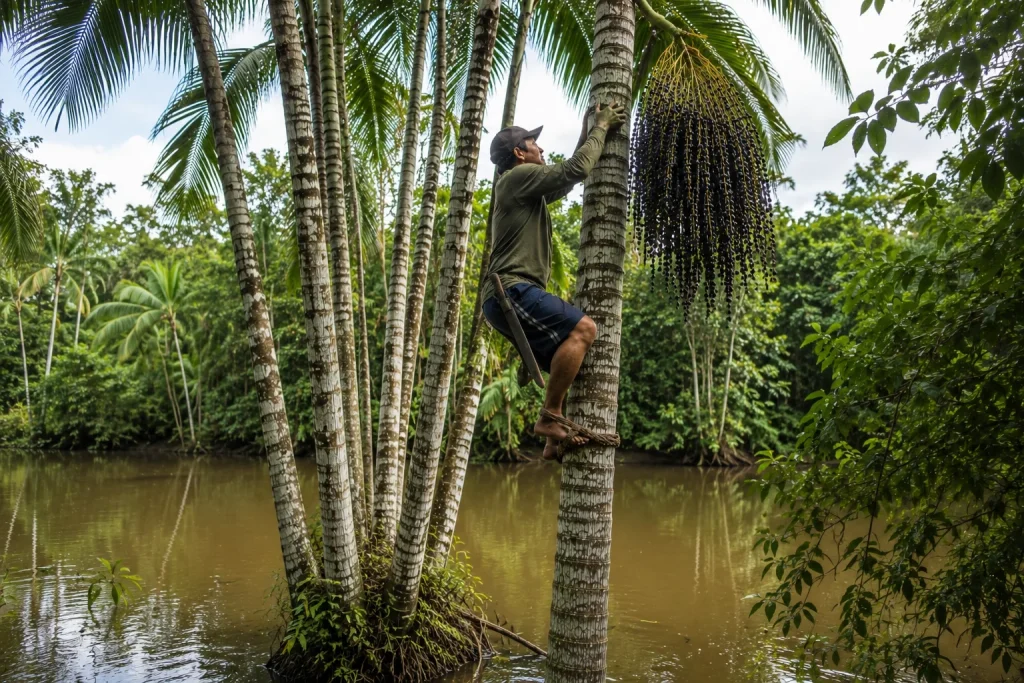
Açaí is harvested almost entirely by hand. Harvesters climb the palm’s smooth trunk using the peconha — a braided plant-fiber loop that wraps around the feet and grips the trunk, letting the climber work their way up. It’s work that demands strength, balance, and hard-won skill — and real risk: according to a survey by the Amazon Environmental Research Institute (IPAM), the climb is often done without protective equipment, and a single mistake can result in a severe or fatal fall.
For many riverine families, açaí harvesting is an important source of income. According to Quaresma and Euler (Embrapa), in Pará — the leading producing state — the açaí harvest tends to concentrate in the second half of the year, with the most intense peak generally reported between September and December; the off-season is concentrated in the first half of the year. This pattern varies by region — in Amapá, for instance, the same source points to a harvest concentrated in the first half of the year — and is subject to significant local variation, even within a single riverine community.
From harvest to processing
Once harvested, the fruit clusters have to move quickly toward processing: the berries begin fermenting just hours after picking, which makes fast transport and cooling essential early steps in the chain. From there, the fruit goes to processing centers, where it’s pulped and, in most cases, frozen to preserve quality and allow transport over longer distances — including for export.
Sustainability challenges
Açaí management is often cited as an example of low-impact extractivism, since harvesting doesn’t require cutting down the palm. Embrapa has spent more than twenty years developing minimum-impact management techniques for native açaí groves, adapted to different conditions across the Amazon.
Even so, the supply chain faces real challenges documented by academic research: a significant share of extractivist workers have no formal employment ties, and there are reports of declining interest in the activity in favor of other land uses — raising concern about cultivation expansion happening in unsustainable ways. Recognizing both sides — the potential of sustainable management and the chain’s real challenges — is part of understanding açaí beyond the finished product on the shelf.
Leave a comment