
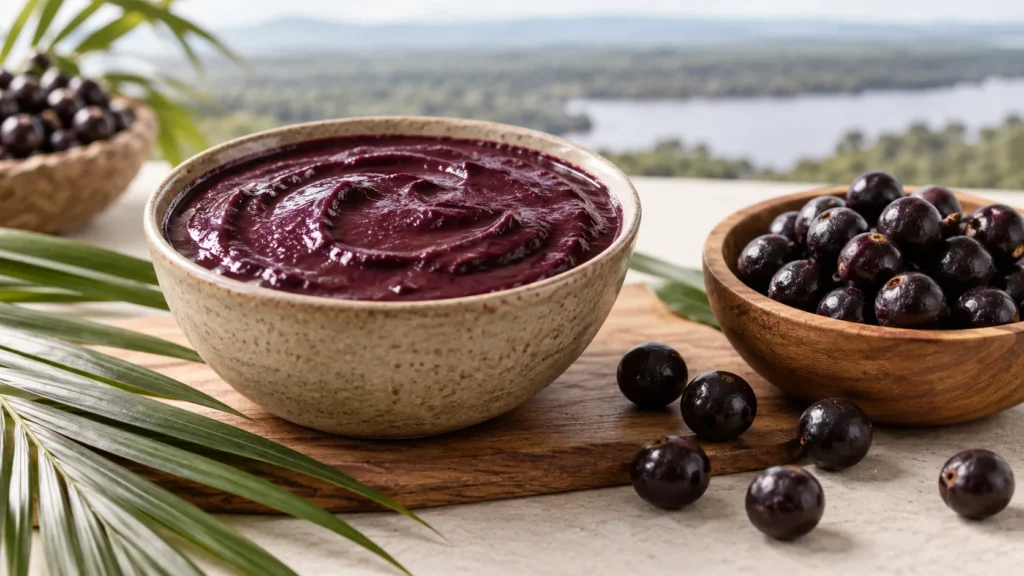
Basic nutritional profile
According to Brazil’s official food composition database (TACO/NEPA-UNICAMP), 100 grams of frozen açaí pulp, with no added sugar or other ingredients, contain approximately 58 kcal, 6.2g of carbohydrates, 0.8g of protein, 3.9g of fat, and 2.6g of fiber. These values shift considerably with preparation: pulp blended with guaraná syrup and glucose, for instance, rises to around 110 kcal per 100g — preparation, not just the fruit itself, drives much of a bowl’s final calorie count.
Bioactive compounds: what research shows so far
What “antioxidant” actually means
Açaí is rich in anthocyanins — the pigments behind its dark purple color — and other phenolic compounds with antioxidant activity. “Antioxidant activity” describes a chemical property measured in the lab — the capacity to neutralize free radicals in a biochemical assay — not, on its own, a demonstration of clinical benefit in the body. In vitro (isolated-sample) and preclinical (animal) studies show these compounds have measurable antioxidant and anti-inflammatory activity in those models — a different thing from proving a clinical effect in people.
In humans, the evidence is more limited, but it exists: small clinical studies have shown that açaí consumption can increase total blood antioxidant capacity and reduce markers of oxidative stress — biomarkers, not clinical outcomes on their own. A 2020 study published in Clinical Nutrition (de Liz et al.), involving 30 healthy adults, found a 66.7% increase in total blood antioxidant capacity after 4 weeks of daily consumption of 200ml of açaí juice. It’s a real result, but from a single small study — raising a blood marker isn’t the same as proving a specific, definitive health benefit, and the finding still needs confirmation from larger research.
What science still doesn’t confirm
This is the most important part of this article: several popular claims attributed to açaí — including weight loss, disease cures, improved sexual performance, “anti-aging” effects, and cancer treatment — are not currently supported by robust clinical evidence in humans.
- Cancer: a Phase 2 clinical trial in patients with recurrent prostate cancer (Kessler et al., using açaí juice) did not meet its primary PSA-response endpoint — only 1 of 21 patients responded. The trial observed a secondary signal (PSA doubling time lengthened in most participants), but a secondary signal without a confirmed primary endpoint doesn’t amount to a proven benefit. Beyond that preliminary signal, the remaining evidence of açaí’s “anticancer” effect comes from preclinical studies, in cells and rodents — not people.
- Cholesterol: a 2025 systematic review and meta-analysis (Candeloro et al., published in Nutrition Bulletin) found a modest reduction in total lipids, but no significant pooled effect on LDL, HDL, total cholesterol, or triglycerides — and the authors themselves rated the certainty of this evidence as low to very low. An earlier individual study (de Liz et al., 2020) had found an HDL increase with açaí juice consumption, but that isolated result wasn’t confirmed when assessed together with the other available studies in the more recent, more comprehensive review.
- Weight loss, athletic performance, erectile dysfunction, skin aging: according to publicly available evidence reviews (NCCIH/NIH), there is no good scientific evidence supporting these popular claims.
One more caution worth noting: a 2019 analysis of 20 commercial açaí supplements (Plant Foods for Human Nutrition) found that more than half of the tested products contained little to no real açaí, and two contained ingredients not listed on the label. It’s a simple reminder — where what you consume comes from matters as much as the substance itself.
Safety and precautions
Raw, unpasteurized açaí juice has been linked, in Brazil, to documented cases of Chagas disease contamination — a risk of improper processing, not of the fruit itself; pasteurized products or juice from controlled sourcing don’t carry that specific risk. Açaí may also interfere with blood glucose control and with MRI scans, and its safety during pregnancy and breastfeeding isn’t well established. Talk to a health professional before consuming açaí regularly in these situations (NCCIH/NIH).
Consuming açaí with balance
Nothing in this article replaces individual nutritional guidance. Açaí is a food that provides fiber, lipids, and bioactive compounds — that doesn’t make it a treatment, a miracle supplement, or a substitute for medical care.
Leave a comment