
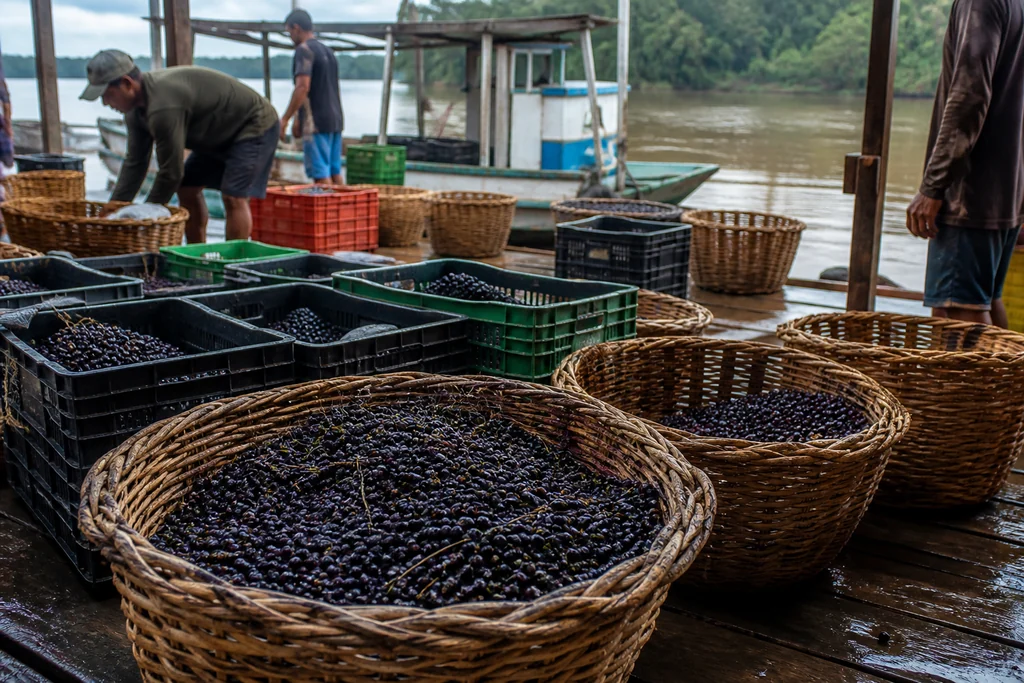
Anyone who buys açaí regularly notices something quickly: the price doesn’t behave the same way all year. In some months, the fruit shows up in force, pulp moves easily, and the product feels less pressured. In other stretches, supply tightens, the price climbs, and every link in the chain feels it, from producer to consumer.
The explanation doesn’t fit in one simple sentence. It’s not just “there’s not enough açaí.” It’s not just “the market is buying more,” either. The swing between harvest season and off-season comes from a combination of nature, management, water, regional origin, transport, processing, and demand.
With açaí, understanding this dynamic matters because the fruit is, at the same time, an everyday food in the Amazon, an income source for producing communities, a raw material for agroindustry, and a product increasingly sought outside the region.
What 2026 showed in Belém
In 2026, this dynamic showed up forcefully in Pará’s local news. During the off-season, local reporting recorded a sharp rise in açaí prices in Belém, tying the move to lower fruit supply, rainfall, difficulty reaching some producing areas, chain costs, and strong demand.
As the regional harvest advanced, starting in May and June, local press began reporting partial declines. Reports based on Dieese/PA surveys indicated that the average price of açaí in Belém dropped in May, after months of increases, and fell again in June. Even so, the same surveys showed that the monthly decline didn’t erase the year’s accumulated increase.
This is the most important point for readers: harvest season doesn’t simply mean “cheap product,” and the off-season doesn’t just mean “expensive product.” The harvest increases availability and tends to ease pressure, but transport, commercialization, quality, processing, demand, and the structure of the supply chain keep influencing the final price.
That’s why 2026’s behavior reinforces this article’s central idea: the price of açaí is the result of an entire supply chain, not just a calendar.
What harvest season and off-season mean for açaí
Harvest season is the period when production and the flow of fruit into the market are most intense. The off-season is the period when that supply becomes more limited. It sounds simple, but with açaí this distinction needs to be read carefully: the Amazon isn’t a single area with the same calendar everywhere.
In Pará, the central reference point for the açaí supply chain, Embrapa notes that the açaí palm can produce year-round, but that the largest commercialized volume tends to concentrate in the second half of the year, a less rainy period across a significant part of the producing region. This concentration helps explain why supply rises during part of the year, and why prices tend to face less pressure when more fruit reaches the market.
During the off-season, relative availability drops. That doesn’t mean açaí disappears. It means supply may depend more on other regions, management systems, irrigation, terra firme cultivation, stocks of processed pulp, and a more demanding logistics operation. According to the same source, this pattern reverses in some higher-rainfall areas — such as the Pará municipality of Gurupá, and the states of Amapá and Maranhão — where production actually peaks during the rainier season, supplying the market precisely during Pará’s off-season.
Why more supply tends to ease pressure on price
Price isn’t just a matter of calendar, but supply matters. When more fruit reaches the market in the same period, buyers, batedores (small-scale processors who buy açaí fruit locally and pulp it), agroindustry, and consumers all find more product available. In general, this eases pressure on price.
The opposite also happens. When production drops, the fruit becomes more contested. If demand stays high, the tendency is for price to rise. This movement can be felt differently at each link in the chain: the price paid to the producer, the cost for the processor, the retail value of the pulp, and the final price to the consumer don’t always move at the same speed.
The price declines recorded in Belém in May and June 2026, as the harvest gradually arrived, help illustrate this movement. At the same time, the reports show that a monthly decline doesn’t automatically erase gains accumulated over the year.
That’s why the best way to explain the off-season isn’t to simply say “açaí gets expensive.” The more useful question is: which part of the chain is putting pressure on price right now?
It could be lower fresh fruit supply. It could be transport cost. It could be competition for higher-quality raw material. It could be urban demand. It could be the need to process and freeze quickly. Often, it’s the sum of several factors.
Why açaí exists outside the main harvest
Even when the main harvest concentrates in a given period, the market keeps consuming açaí year-round. That’s possible because supply doesn’t come from a single source.
Part of the product may come from areas with a different calendar. Another part may come from systems managed to stagger production. There’s also terra firme production — cultivation on land that doesn’t flood seasonally — plus irrigation initiatives and growing technologies aimed at reducing seasonality and giving supply more regularity.
Inflorescence management, cited by Embrapa, appears in this context as a technical practice capable of influencing production outside the most abundant period. Irrigation can also play an important role, especially when soil water availability limits the plant’s development.
But caution is needed: management and irrigation aren’t a magic wand. They depend on technical knowledge, cost, environment, scale, variety, infrastructure, and follow-up. What works in one area may not automatically be reproducible in another.
Water is central to the conversation
For the açaí palm, water isn’t a minor detail. Water availability influences growth, production, and regularity. In periods of lower rainfall, or in areas where soil water doesn’t adequately meet the plant’s needs, production can be affected.
That’s why irrigation appears in technical publications as an important tool in certain cultivation systems. It can help reduce water stress and make production more predictable, but it also requires planning, investment, and responsible water use.
For the general reader, the central point is this: the off-season isn’t just a date on a calendar. It also reflects the relationship between the plant, climate, soil, water, and management.
Harvest, transport, and processing also change supply
Açaí has another decisive characteristic: the fruit needs to move quickly from harvest to processing. That creates a time-sensitive chain.
Once harvested, the fruit needs to be stripped from the stem, transported, cleaned, and processed. Depending on the distance between the producing area, port, road, batedor, agroindustry, or consumer center, cost and difficulty increase.
In markets far from the Amazon, supply depends even more on processing, freezing, storage, and adequate transport. When someone finds açaí in a city far from the producing region, they’re seeing the result of an entire supply chain, not just a harvest.
This is one of the reasons why price and availability can vary even when there is production. Not every piece of fruit available in a producing area arrives at the same time, with the same quality, and at the same cost to the final consumer.
Local market, national market, and international market
In the Amazon, açaí is an everyday food and part of the food culture. Outside the region, it often shows up as frozen pulp, cream, bowls, beverages, an industrial ingredient, or a product associated with an urban lifestyle.
That difference matters. When demand grows in national and international markets, the supply chain needs to respond with volume, quality, regularity, and traceability. That can open opportunities, but it also creates pressure: on raw material, on logistics, on standardization, and on processing.
Even so, it’s important not to oversimplify. There’s no way to say that exports alone explain the local price without specific data. External demand can be part of the equation, but it needs to be read together with the off-season, quality, costs, atravessadores (middlemen), processing, logistics, and regional consumption.
What to watch for, without oversimplifying
For anyone who consumes, buys, or follows the açaí market, a few questions help more than ready-made answers:
- Which region does the product come from?
- Is it that origin’s peak harvest period?
- Does the price reflect fresh fruit, processed pulp, transport, or quality?
- Is there a difference between the price paid to the producer and the price to the final consumer?
- Does the product depend on freezing, long-distance transport, or an industrial standard?
- Is the information about the harvest talking about Pará, another Amazonian region, or all of Brazil?
These questions help avoid a shallow reading. Açaí isn’t just a fruit that “gets expensive” in certain months. It’s part of a living chain, with rivers, roads, agroindustries, markets, batedores, communities, cultivation, extractivism, and a global market.
Why this topic matters for Açaí Atlas
Talking about harvest season and the off-season means talking about how açaí actually exists before it reaches a cup, a bowl, or a package. It means looking at the food as part of a territory, an economy, and a productive culture.
When the price changes, there’s a story behind it. Sometimes it starts with the production calendar. Sometimes it starts with rain. Sometimes it runs through management, irrigation, transport, processing, or demand. Almost always, it runs through more than one of these points at the same time.
Understanding this helps move açaí out of the category of generic product or global trend. It’s an Amazonian food with its own supply chain, its own rhythm, and its own challenges.
And that’s exactly where harvest season and the off-season stop being just a matter of price. They show how nature, local knowledge, technique, and market come together around one of the Amazon’s most important fruits.
Leave a comment